Machine Learning Program

- Description
- Curriculum
- Reviews
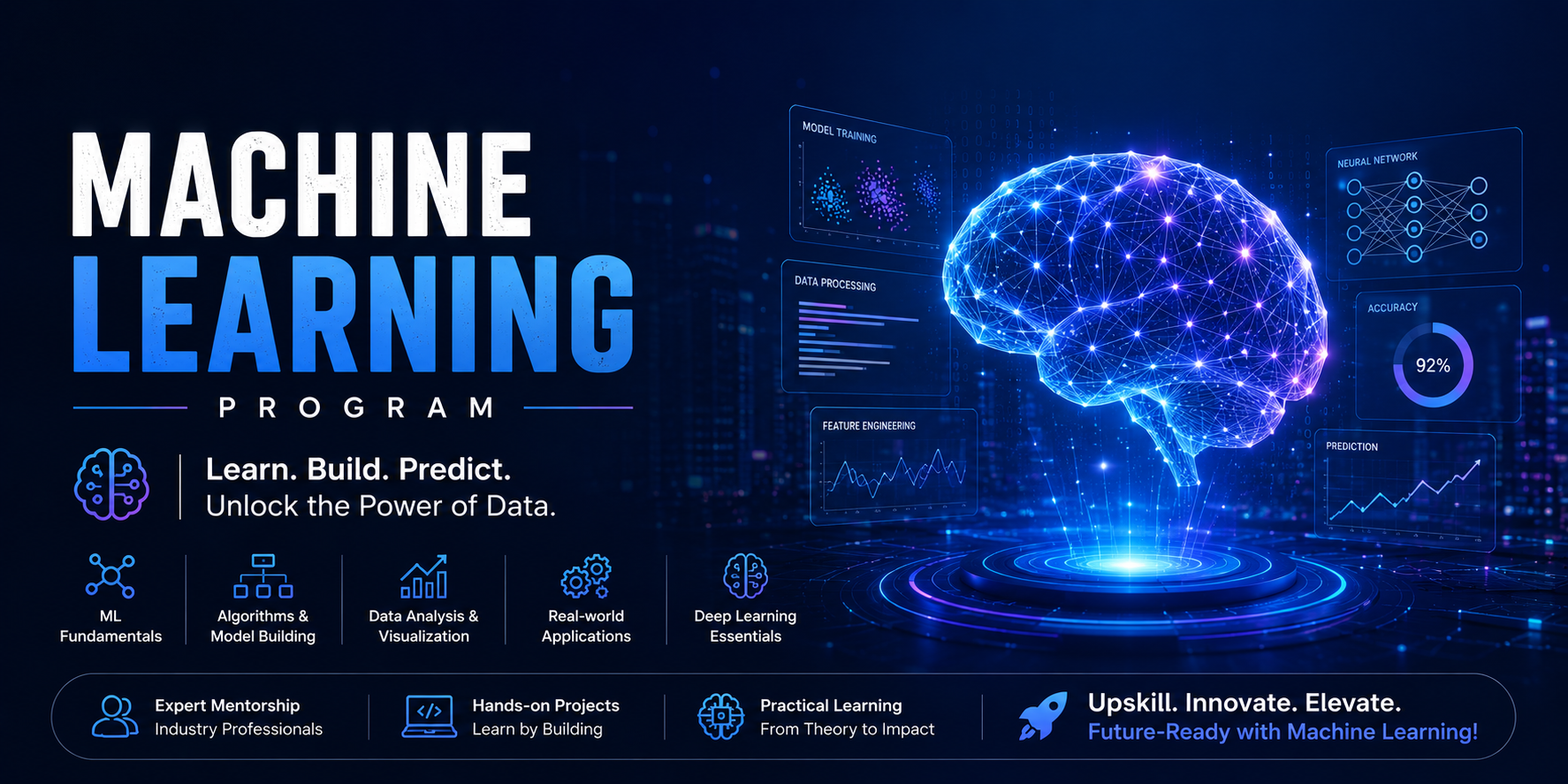
Throughout the program, you will gain in-depth knowledge of core machine learning concepts such as supervised and unsupervised learning, data preprocessing, feature engineering, and model evaluation. You will work with industry-standard tools and technologies including Python, NumPy, Pandas, Scikit-learn, and popular frameworks like TensorFlow and PyTorch.
You will learn how to build predictive models, train algorithms, and analyze large datasets to extract meaningful insights. The course also covers advanced topics such as deep learning, neural networks, natural language processing (NLP), and computer vision, enabling you to develop intelligent applications used in real-world scenarios.
This program emphasizes hands-on learning, allowing you to work on real-world projects that simulate actual industry challenges. You will gain practical experience in building machine learning models, deploying them into production, and optimizing their performance. Step-by-step guidance and expert mentorship ensure that even beginners can follow along and build confidence quickly.
By the end of the course, you will be capable of developing machine learning models, solving complex data problems, and deploying AI-driven solutions effectively. You will also understand best practices for model tuning, validation, and scalability. The program equips you with job-ready skills and prepares you for roles such as Machine Learning Engineer, Data Scientist, and AI Specialist.
Whether you are a student, IT professional, or entrepreneur, this program provides the perfect opportunity to enter the fast-growing field of artificial intelligence and future-proof your career with in-demand skills.
-
1
 Introduction to Machine Learning (Types, Applications)
 -
2
Python for ML (NumPy, Pandas)
Day 2 focuses on using NumPy and Pandas for machine learning, covering array operations, data manipulation, cleaning, filtering, and preparing structured datasets for ML models.
-
3
Data Preprocessing (Cleaning, Encoding)
Day 3 covers essential data preprocessing techniques including data cleaning, handling missing values, outlier treatment, and encoding categorical variables to prepare datasets for machine learning models.
-
4
Exploratory Data Analysis (Visualization)
Day 4 focuses on Exploratory Data Analysis (EDA), using statistical summaries and data visualization techniques to understand patterns, relationships, trends, and anomalies in datasets.
-
5
Statistics Basics
Day 5 covers fundamental statistical concepts including mean, median, variance, probability, distributions, and hypothesis testing essential for understanding and building machine learning models.
-
6
Linear Algebra Basics
Day 6 introduces essential linear algebra concepts including vectors, matrices, matrix operations, dot product, eigenvalues, and eigenvectors, which form the mathematical foundation of machine learning algorithms and model optimization techniques.
-
7
 Mini Project (Data Cleaning & Visualization)
Day 7 focuses on a hands-on mini project where learners apply data cleaning and visualization techniques to a real dataset. It involves handling missing values, removing duplicates, encoding variables, performing exploratory data analysis (EDA), and creating meaningful visualizations to extract insights.
-
8
Linear Regression
Day 8 introduces Linear Regression; a supervised learning algorithm used to model relationships between variables and predict continuous outcomes using a best-fit line.
-
9
Multiple Linear Regression
Day 9 covers Multiple Linear Regression, a supervised learning algorithm that predicts a continuous outcome using two or more independent variables, explaining how multiple features collectively influence a dependent variable.
-
10
Logistic Regression
Day 10 introduces Logistic Regression, a supervised classification algorithm used to predict categorical outcomes. It explains the sigmoid function, probability estimation, decision boundaries, and how logistic regression differs from linear regression in handling binary and multiclass classification problems.
-
11
KNN Algorithm
Day 11 introduces the K-Nearest Neighbors (KNN) algorithm, a supervised learning method used for classification and regression. It explains distance metrics, the role of K, decision boundaries, and how KNN makes predictions based on similarity between data points.
-
12
Decision Trees
Day 12 introduces Decision Trees, a supervised learning algorithm used for classification and regression. It explains tree structure, splitting criteria, entropy, information gain, Gini index, overfitting, pruning techniques, and how decision trees make rule-based predictions.
-
13
Model Evaluation Metrics
Day 13 explains Model Evaluation Metrics used to measure machine learning performance. It covers regression metrics like MAE, MSE, RMSE, and R², and classification metrics including accuracy, precision, recall, F1-score, and confusion matrix to assess model effectiveness.
-
14
Mini Project (Prediction Model)
Day 14 focuses on a hands-on mini project where learners build a complete prediction model. It covers data preprocessing, feature selection, model training, evaluation, and performance improvement to solve a real-world regression or classification problem using machine learning algorithms.
-
15
Clustering Basics
Day 15 introduces Clustering Basics, an unsupervised learning technique used to group similar data points without labelled outcomes. It covers key concepts such as similarity measures, distance metrics, cluster formation, and popular algorithms like K-Means and Hierarchical Clustering.
-
16
K-Means Clustering
Day 16 focuses on K-Means Clustering, an unsupervised learning algorithm that groups similar data points into K clusters based on distance from centroids, using iterative updates to minimize within-cluster variance and improve grouping accuracy.
-
17
Hierarchical Clustering
Day 17 introduces Hierarchical Clustering, an unsupervised learning algorithm that builds nested clusters using a tree-like structure called a dendrogram, explaining agglomerative and divisive approaches, linkage criteria, and cluster interpretation without predefining the number of clusters.
-
18
PCA
Day 18 introduces Principal Component Analysis (PCA), a dimensionality reduction technique used to transform high-dimensional data into fewer meaningful components while retaining maximum variance. It explains variance, covariance matrix, eigenvalues, eigenvectors, feature transformation, and how PCA improves visualization, reduces overfitting, and enhances computational efficiency in machine learning models.
-
19
Association Rule Learning
Day 19 introduces Association Rule Learning, an unsupervised learning technique used to discover interesting relationships and patterns between variables in large datasets. It explains support, confidence, lift, and algorithms like Apriori and FP-Growth used for market basket analysis and recommendation systems.
-
20
Mini Project (Customer Segmentation)
Day 20 focuses on a hands-on mini project where learners perform customer segmentation using clustering techniques. The session includes data preprocessing, exploratory data analysis, feature scaling, applying clustering algorithms like K-Means, and interpreting customer groups to generate actionable business insights.
-
21
Random Forest
Day 21 introduces Random Forest, an ensemble learning algorithm that combines multiple decision trees to improve prediction accuracy and reduce overfitting. It explains bagging, feature randomness, majority voting, regression averaging, and how Random Forest enhances model stability and performance.
-
22
Boosting Techniques
Day 22 introduces Boosting Techniques, an ensemble learning approach that improves model accuracy by sequentially training weak learners and correcting previous errors. It covers concepts like AdaBoost, Gradient Boosting, and XGBoost, explaining how boosting reduces bias, improves predictive performance, and handles complex datasets effectively.
-
23
Support Vector Machines
Day 23 introduces Support Vector Machines (SVM), a supervised learning algorithm used for classification and regression. It explains hyperplanes, margin maximization, support vectors, kernel functions, and how SVM handles both linear and non-linear data by transforming feature space for optimal decision boundaries.
-
24
Cross Validation
Day 24 introduces Cross Validation, a model evaluation technique used to assess machine learning performance by splitting data into multiple training and testing sets. It explains k-fold cross validation, stratified sampling, bias-variance tradeoff, and how cross validation ensures reliable and generalized model performance.
-
25
Hyperparameter Tuning
Day 25 introduces Hyperparameter Tuning, a process used to optimize machine learning models by selecting the best configuration of external parameters. It covers Grid Search, Random Search, cross-validation integration, overfitting control, and how tuning improves model accuracy, stability, and generalization performance.
-
26
Feature Selection
Day 26 introduces Feature Selection, a technique used to identify and retain the most relevant input variables for machine learning models. It explains filter, wrapper, and embedded methods, reducing dimensionality, improving model performance, minimizing overfitting, and enhancing computational efficiency.
-
27
ML Pipeline
Day 27 introduces the Machine Learning (ML) Pipeline, a structured workflow that automates data preprocessing, feature engineering, model training, evaluation, and deployment. It explains pipeline components, reproducibility, scalability, and how pipelines improve efficiency, reduce errors, and ensure consistent model performance in production environments.
-
28
Model Deployment (Flask/Fast API
Day 28 introduces Model Deployment using Flask and FastAPI, explaining how to convert trained machine learning models into web APIs. It covers REST APIs, request-response handling, model serialization, JSON input processing, and deploying models for real-time predictions in production environments.
-
29
Case Studies
Day 29 focuses on real-world machine learning case studies, demonstrating how ML concepts are applied to solve practical business problems. It covers end-to-end workflows including data preprocessing, model selection, evaluation, optimization, and deployment across domains like healthcare, finance, retail, and marketing.
-
30
Final Project
Day 30 focuses on the Final Project, where learners apply the complete machine learning workflow to solve a real-world problem. It includes data preprocessing, exploratory analysis, feature engineering, model building, evaluation, tuning, and deployment, demonstrating end-to-end understanding and practical implementation skills.
This Machine Learning Program is designed for beginners, so the requirements are minimal:
-
Basic Computer Knowledge
-
Laptop or Desktop
-
Stable Internet Connection
-
Basic Mathematics Understanding
-
No Prior Machine Learning Experience Required
-
Basic Programming Knowledge (Optional)
The Machine Learning Program by VeduTech INUskill is designed for:
- Students (Class 11–12, Diploma, Undergraduate) who want to start learning Artificial Intelligence and Machine Learning early.
- College Students (B.Tech, BCA, MCA, B.Sc IT, etc.) looking to build strong ML fundamentals and improve their resume.
- Beginners with No Prior Coding Experience who want a structured and easy introduction to Machine Learning.
- Working Professionals who want to switch careers into Data Science or AI.
- IT Professionals & Developers aiming to upskill in Machine Learning.
- Job Seekers who want practical projects and a certificate to strengthen their job profile.
- Entrepreneurs & Tech Enthusiasts interested in understanding how ML works in real-world applications.